
The Ultimate Guide to Electrical Hook Up for Your UK Campervan
Alright, let's talk about hooking your campervan up to the mains. For me, a robust Electrical Hook Up (EHU) system is non-negotiable. It’s what transforms your rolling home from a fancy tent into a proper, comfortable living space, allowing you to power everything from your kettle to your laptop without constantly worrying about draining your leisure batteries. This isn’t just about convenience; it’s about safety and peace of mind on the road, whether you're parked up at a tranquil campsite in the Peak District or charging at home.
I've built a few of these systems myself, and honestly, trying to cut corners on EHU is just asking for trouble. We're dealing with 230 volts here, the same stuff that powers your house. Get it wrong, and you're looking at potential fires, electrocution, or at the very least, a constantly tripping RCD that'll drive you mad. This guide will walk you through everything you need to know to get your campervan safely and effectively connected to the grid.
What Exactly is Electrical Hook Up (EHU)?
Simply put, Electrical Hook Up (EHU), often called shore power, is the system that lets you connect your campervan to an external 230V AC (Alternating Current) electricity supply. Think of it like plugging your house into a giant extension lead. This external supply usually comes from a dedicated hook-up point at a campsite, a friend's driveway, or even your own garage.
This means you can power your 230V appliances directly, without relying on your leisure batteries or an inverter. It also means you can charge your leisure batteries efficiently, ensuring they're topped up and ready for off-grid adventures. For most builders, EHU is a fundamental part of a comprehensive campervan electrical system, complementing your 12V DC setup and any solar panels you might have. It gives you the best of both worlds: mains power when you need it, and battery power when you don't.
Understanding the Electrical Basics
Before we dive into components, let's quickly clarify some terms. It's not rocket science, but knowing the lingo helps immensely.
AC vs. DC: The Two Flavours of Power
Your campervan typically runs on two types of electricity:
- DC (Direct Current): This is what your leisure batteries provide, usually 12V. All your USB chargers, LED lights, water pumps, and most fridges run on DC.
- AC (Alternating Current): This is your mains electricity, 230V in the UK. Your household appliances like kettles, toasters, hair dryers, and laptops use AC.
This means your EHU system is all about bringing that 230V AC power into your van. Your 12V system is separate but often interacts with the AC system, especially when it comes to charging your batteries.
Amperage (A), Voltage (V), and Wattage (W): The Power Trio
These three terms describe how electricity behaves:
- Voltage (V): Think of this as the "pressure" of the electricity. In the UK, mains supply is 230V. Your campervan's leisure system is 12V.
- Amperage (A): This is the "flow" or "current" of electricity. Campsite hook-ups typically provide 6A, 10A, or 16A. This is crucial as it dictates how many appliances you can run simultaneously.
- Wattage (W): This is the actual "power" an appliance consumes or provides. It's calculated by Voltage x Amperage (P = V x I). So, a 10A hook-up at 230V gives you 2300W of power (2.3kW).
In practice, a 16A hook-up is the most generous, offering up to 3680W. A 6A hook-up, common on some older or smaller sites, gives you 1380W. You need to be mindful of these limits. Plugging in a 2kW kettle on a 6A hook-up will trip the campsite's breaker every single time. Honestly, it's frustrating for everyone, so understand your limits.
The Essential Components of Your EHU System
Building a safe and reliable EHU system involves several key components, each playing a vital role. Don't cheap out on these; they're the backbone of your electrical safety.
1. External Hook-Up Point (Inlet Socket)
This is where the magic begins – the port on the outside of your campervan where you plug in the shore power cable.
- Type: You'll need a blue 16A CEEform inlet socket. These are standard across Europe for leisure vehicles. You can get surface-mounted ones (easier to install, but protrude) or flush-mounted ones (neater, requires cutting a larger hole).
- Rating: Ensure it's IP44 rated at minimum, meaning it's splash-proof and suitable for outdoor use. Many are IP67, offering even better water ingress protection.
- Cost: Expect to pay £15-£40 for a good quality inlet socket from brands like Mains Power, C-Line, or CBE. For most builders, the flush-mounted version looks much tidier.
My advice is to choose a high-quality, reputable brand. This is your first line of defence against water getting into your system. Don't just pick the cheapest one on Amazon; look for marine-grade or caravan-specific options.
2. The Hook-Up Cable (Shore Power Lead)
This is the big orange (or sometimes black) cable that connects your van's inlet socket to the campsite's hook-up bollard.
- Connectors: It must have two blue 16A CEEform connectors – one male plug for the campsite, one female socket for your van.
- Cable Type: Crucially, it must be a heavy-duty, flexible, outdoor-rated cable, typically 2.5mm² H07RN-F rubber cable. This cable is designed to withstand UV, oil, and mechanical stress. Using a flimsy domestic extension lead is a recipe for disaster and a fire hazard.
- Length: A 25-metre lead is standard and highly recommended. Campsite hook-up points aren't always right next to your pitch. A 10m or 15m cable might seem fine until you're struggling to reach the bollard.
- Cost: A good quality 25m 16A hook-up lead will set you back £40-£80. It's an essential purchase; don't compromise here.
This means you need to store this cable neatly when not in use. A dedicated cable bag keeps it tidy and prevents it from tangling with everything else in your garage or locker.
3. Consumer Unit (RCD & MCBs)
This is the absolute heart of your EHU system's safety. It's identical in principle to the fuse box in your house, just scaled down for your van. It provides critical protection against electric shock and electrical fires.
- RCD (Residual Current Device): This is your life-saver. It constantly monitors the current flowing into and out of your van. If it detects an imbalance (meaning current is leaking to earth – e.g., through you!), it trips almost instantly, cutting the power. You absolutely need one, typically a 25A 30mA RCD.
- MCBs (Miniature Circuit Breakers): These protect individual circuits from overcurrents (too many appliances running on one circuit) and short circuits. You'll usually have one MCB for your 230V sockets (e.g., 10A or 16A) and another for your battery charger (e.g., 6A or 10A).
- Integrated Units: For campervans, you can buy compact consumer units that combine the RCD and two or three MCBs in one small enclosure. Brands like CBE, Sargent, and Ring are common.
- Cost: A decent compact consumer unit with RCD and two MCBs will cost £60-£150. This is not an area to save money on.
Honestly, if you only take one piece of advice from this guide, it's this: DO NOT skimp on your consumer unit and its protective devices. This is what keeps you alive.
4. Internal Wiring
The cables inside your van that distribute the 230V power from your consumer unit to your sockets and appliances.
- Type: You need 3-core PVC insulated and sheathed cable, commonly known as twin and earth (T&E). However, for a vehicle, flexible cable is often preferred to withstand vibrations. Look for 3-core 2.5mm² flexible cable (e.g., Arctic grade or specific caravan cable) for your main socket circuits and 1.5mm² for fixed appliances like a fridge (if AC) or a dedicated heater circuit.
- Colours: In the UK, live is brown, neutral is blue, and earth is green and yellow striped. Stick to these religiously.
- Routing: Cables should be routed safely, away from sharp edges, heat sources, and potential crushing points. Use conduit or cable clips.
For most builders, 2.5mm² flexible cable is the safest bet for all 230V socket circuits. It offers good current carrying capacity and is more resilient to vibration than solid core T&E.
5. Internal 230V Sockets
Standard UK 3-pin sockets, just like in your home.
- Quantity: Think about where you'll need power. A couple in the kitchen area, one near the bed, perhaps one for a TV. Don't go overboard; each socket needs to be connected safely.
- Type: Choose good quality, robust sockets. Integrated USB & charging points are a nice touch for phones and tablets.
- Mounting: Ensure they are securely mounted to your van's structure, not just flimsy panelling.
- Cost: £5-£20 per socket, depending on features and brand.
6. Battery Charger (230V to 12V)
When you're hooked up to the mains, you'll want to charge your leisure batteries. This is where a dedicated 230V battery charger comes in.
- Function: It takes the 230V AC from your EHU system and converts it into 12V DC to charge your batteries.
- Smart Chargers: Look for a "smart" or "multi-stage" charger. These adapt their charging profile to your battery's state, preventing overcharging and extending battery life.
- Amperage: The charging current (e.g., 20A, 30A) determines how quickly your batteries will charge. A 20A charger will replenish a 100Ah battery in about 5-6 hours from 50% depth of discharge.
- Integration: Many all-in-one power management units (like those from Sargent or CBE) include a built-in charger. If not, you'll buy it separately.
- Cost: A good quality smart charger will cost £100-£300, depending on its output current and features. Brands like Victron Energy, Sterling Power, and CTEK are excellent choices.
This means your EHU system isn't just about powering appliances; it's also your primary method for keeping your leisure batteries topped up when not relying on solar or your alternator.
7. Adapters (Like the VELPAX 16A to 13A UK Hook Up Adapter Lead)
These are handy accessories, not core components, but incredibly useful.
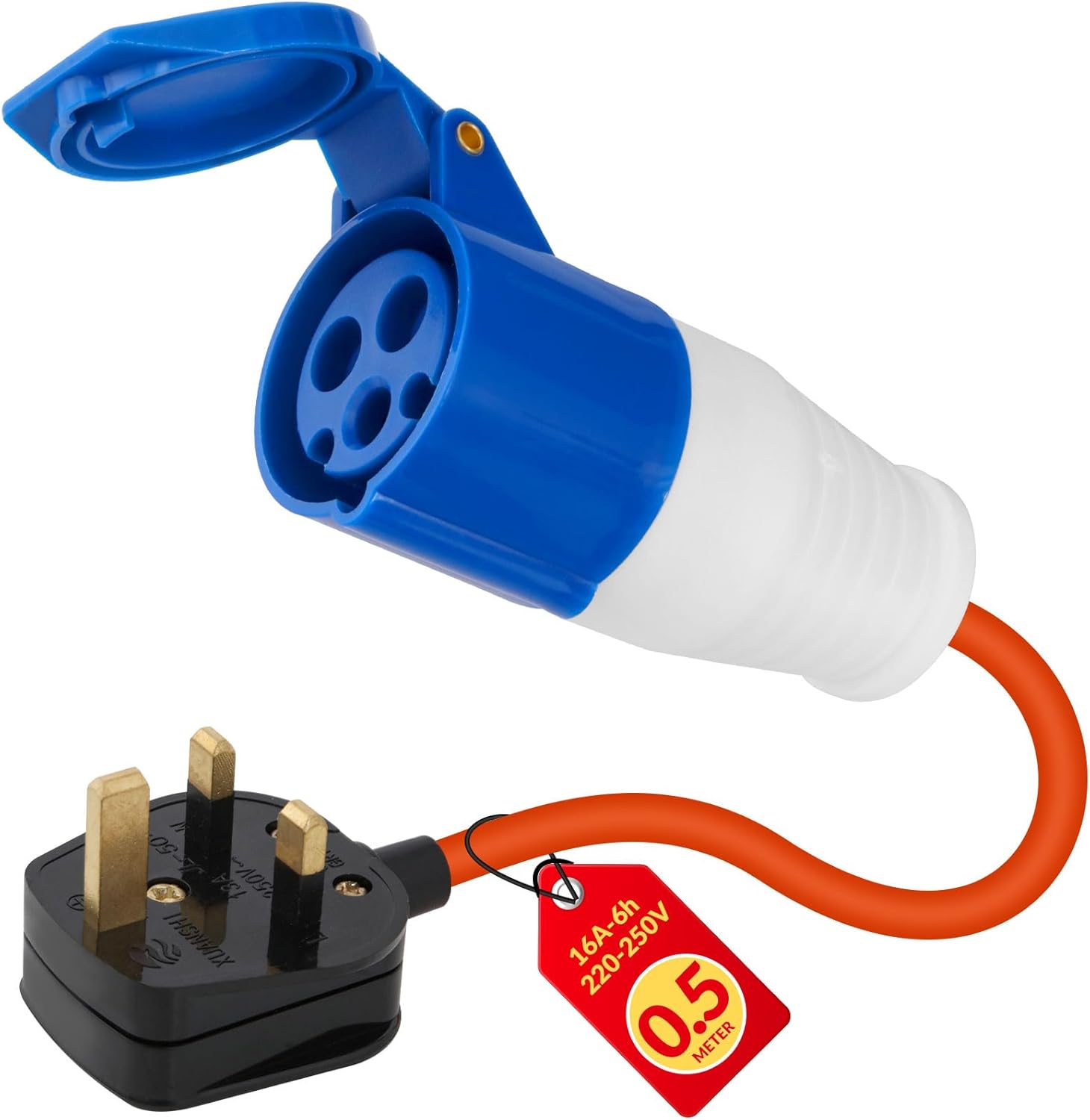
VELPAX 16A to 13A UK Hook Up Adapter Lead (£8.99): This specific product allows you to connect your campervan's standard blue 16A CEEform inlet to a regular UK 3-pin 13A domestic socket.
- When to use it: Perfect for charging your van at home, at a friend's house, or anywhere with a standard domestic socket, assuming you only need to draw a maximum of 13A (or less, depending on the circuit).
- Safety Note: This adapter does not magically increase the power available. You're still limited by the domestic socket's 13A fuse. More importantly, domestic sockets are not protected by a campsite RCD. Ensure the circuit you plug into at home is RCD protected. If not, consider a portable RCD adapter for extra safety.
- My Opinion: Every campervan owner should have one of these. It's invaluable for pre-trip charging or trickle charging your batteries over winter. Just be sensible with what you plug in. Don't run your kettle, toaster, and hairdryer all at once through a domestic socket!
Continental Adapters: If you plan to travel in Europe, you might need adapters for different CEEform standards (e.g., 2-pin for some older continental sites), though the blue 16A CEEform is becoming increasingly universal.
Planning Your EHU System: Get it Right First Time
A little planning goes a long way. This isn't just about buying parts; it's about designing a safe, functional system for your specific needs.
Assessing Your Power Needs
Start by listing every 230V appliance you plan to use in your van.
- Kettle (typically 1500W-2200W)
- Toaster (700W-1200W)
- Hair dryer (1000W-2000W)
- Laptop charger (50W-100W)
- Electric heater (500W-2000W)
- Microwave (600W-1000W)
- Battery charger (e.g., 20A charger draws approx 300W-400W from 230V)
Add up the wattage of the appliances you might use simultaneously.
Example: On a 10A hook-up (2300W total), you could run a 1500W kettle, but not a 2000W kettle. You could run a 1000W hair dryer and charge your batteries (300W), but adding a 700W toaster would likely trip the breaker (1000 + 300 + 700 = 2000W, well within 2300W, but add some buffer).
This means you need to be realistic. You're not going to run a full household of appliances off a 6A hook-up. Manage your expectations and your usage.
Choosing the Right Components: Sizing and Ratings
- Consumer Unit: Ensure the RCD is 30mA (for human protection) and rated for at least 25A. MCBs should be sized for their circuits: 10A or 16A for sockets, 6A or 10A for chargers/fixed appliances.
- Cables:
- Hook-up cable: Always 2.5mm² H07RN-F.
- Internal mains circuits: 2.5mm² flexible cable for sockets, 1.5mm² for lower-power fixed appliances.
- Inlet Socket: 16A CEEform, IP44 or higher.
For most builders, sticking to these standard sizes ensures both safety and compliance. Don't guess; follow the guidelines.
Safety First: Regulations and Professional Installation
This is the most critical part. Electricity can kill.
- BS 7671 (IET Wiring Regulations): This is the bible for electrical installations in the UK. While technically not legally binding for DIY campervan conversions (as they aren't "dwellings" in the traditional sense), adhering to these regulations is the gold standard for safety. Any qualified electrician will work to these.
- Professional Check: Even if you do the installation yourself, I strongly, strongly recommend having a qualified electrician inspect and test your EHU system. They can issue an Electrical Installation Condition Report (EICR) or similar certificate, which is invaluable for peace of mind, insurance, and potential resale. This typically costs £100-£250.
- Earthing: Proper earthing is paramount. Your entire EHU system must be correctly earthed to the chassis of your van, which then connects to the campsite's earth via your hook-up cable. This provides a safe path for fault currents.
My opinionated take? If you're not confident with household electrics, don't even think about tackling 230V yourself. Get a professional. It's not worth the risk. If you are confident, still get it checked.
Installation Tips and Best Practices
So, you've got your components, and you're ready to get stuck in. Here are some pointers.
Mounting the Inlet Socket
- Location: Choose a spot that's easily accessible but protected from road spray and potential damage. Near the rear or side is common.
- Cut the Hole: Use a holesaw for a neat finish. For flush-mounted sockets, ensure the hole is the correct diameter. Seal around the edges with a good quality marine sealant (like Sikaflex 221 or CT1) to prevent water ingress.
- Secure Fastening: Bolt or screw the inlet socket securely to your van's bodywork. Use stainless steel fasteners to prevent corrosion.
Cable Routing and Protection
- Separation: Keep your 230V AC cables physically separate from your 12V DC cables. Running them together can cause interference (noise) on your 12V system and makes fault finding harder. Aim for at least 150mm separation.
- Conduit/Trunking: Run cables inside protective conduit or trunking wherever possible. This protects them from abrasion, pests, and accidental damage.
- Avoid Pinch Points: Ensure cables aren't pinched by panels, doors, or furniture. Use grommets when passing cables through metalwork.
- Secure Fastening: Use cable clips or ties every 30-50cm to secure cables, preventing them from flapping around or coming loose due to vibration.
Wiring the Consumer Unit
- Follow the Diagram: Your consumer unit will come with a wiring diagram. Follow it precisely.
- Connections: Ensure all connections are tight and secure. Loose connections are a major cause of resistance, heat, and potential fires. Use crimps for flexible cable connections where appropriate.
- Earth Bonding: Connect the earth wire from your inlet socket to the earth bar in your consumer unit. Then, run a separate, substantial earth cable (e.g., 6mm² or 10mm²) from your consumer unit's earth bar to a solid point on your van's metal chassis. This is your main earth bond.
This means you need to be methodical. Double-check every connection. A simple mistake here can have serious consequences.
Wiring the 230V Sockets
- Ring or Radial: For a campervan, a simple radial circuit is usually sufficient. Run a single 2.5mm² cable from your consumer unit's MCB to your first socket, then loop to the next, and so on. Don't create a ring main like in a house unless you're a qualified electrician and understand the implications.
- Correct Terminals: Connect live (brown), neutral (blue), and earth (green/yellow) to the correct terminals on each socket.
- Back Boxes: Mount sockets in proper back boxes, especially if they are recessed into your panelling.
Testing Your System
Once everything is wired, do not just plug it in and hope for the best!
- Visual Inspection: Before applying power, thoroughly check all connections. Are they tight? Are the correct wires in the correct terminals? Is there any exposed copper?
- Continuity Test: Use a multimeter to check for continuity on your earth circuit from the inlet socket to your van's chassis and to each socket's earth pin.
- Insulation Resistance Test: A qualified electrician will perform this to ensure there are no shorts between live, neutral, and earth.
- RCD Test: Most RCDs have a "test" button. Once powered, press it. The RCD should trip immediately. If it doesn't, there's a problem.
In practice, this is where that professional inspection really pays off. They have the right testing equipment and expertise to ensure everything is safe.
Using Your EHU System
So you've built it, had it checked, and it's working. Now for the fun part: using it!
Connecting to Campsite Hook-Up
- Preparation: Ensure all your 230V appliances in the van are switched off.
- Connect to Van: First, plug the female end of your hook-up lead into your van's external inlet socket.
- Connect to Campsite: Then, plug the male end of your hook-up lead into the campsite's hook-up bollard.
- Engage Power: Switch on the power at the campsite bollard (if it has a switch).
- Check Van's RCD: Go inside your van and ensure your RCD hasn't tripped. If it has, reset it. If it trips again, there's a fault in your van, or the campsite's supply has an issue.
- Switch On Appliances: You can now safely switch on your 230V appliances and your battery charger.
This means always connecting to the van first and disconnecting from the campsite first. This minimises the risk of live exposed pins.
Common Issues and Troubleshooting
- RCD Tripping:
- Campsite RCD trips: You're probably drawing too much power for the campsite's supply. Turn off some high-wattage appliances. Could also be a fault in your van or the campsite's supply.
- Van's RCD trips: This indicates a fault within your van's electrical system or an appliance. Unplug all 230V appliances, reset the RCD. If it holds, plug appliances back in one by one until it trips again, identifying the faulty item. If it still trips with nothing plugged in, the fault is in your fixed wiring or consumer unit. Call an electrician.
- No Power:
- Is the campsite bollard switched on?
- Is your hook-up cable fully plugged in at both ends?
- Is the campsite's supply working (check other vans)?
- Has an MCB in your consumer unit tripped?
- Low Voltage: Rare in the UK, but can happen on busy sites or with very long, thin hook-up cables. If your appliances aren't performing well, it could be a voltage drop.
For most builders, a methodical approach to troubleshooting is key. Don't panic; work through the possibilities one by one.
Maintenance
- Cable Inspection: Regularly inspect your hook-up lead for damage (cuts, cracks, exposed wires). Replace it immediately if damaged.
- Inlet Socket: Keep the inlet socket clean and free of dirt or water. Check the seal periodically.
- Consumer Unit: Occasionally check connections in your consumer unit for tightness. Test your RCD regularly using the test button (e.g., once a month).
- Battery Charger: Ensure it's operating correctly and not overheating.
Beyond the Basics: Enhancements and Considerations
Once you've got a solid EHU system, you might start thinking about how it integrates with other power sources.
Integrating with Solar
Your EHU system and campervan solar panels work beautifully together. When hooked up, your 230V battery charger will keep your leisure batteries topped up. When off-grid, your solar charge controller takes over. This means you have multiple ways to keep your batteries healthy, extending your adventures.
Shore Power vs. Inverter Power
- Shore Power: This is the 230V AC directly from your EHU. It's clean, unlimited (within the hook-up's amperage), and doesn't drain your batteries.
- Inverter Power: An inverter takes your 12V DC battery power and converts it to 230V AC. It allows you to run AC appliances when off-grid.
In practice, you'll use shore power when available, and your inverter when off-grid. A good power management system will often prioritise shore power for charging and AC loads.
Generator Backup
Some campervan owners carry a small portable generator. This can provide 230V AC when off-grid and away from hook-ups, acting like a temporary EHU. It's useful for charging batteries or running high-wattage appliances when solar isn't enough. Just be mindful of noise and fuel.
Making Your Purchase Decisions: What to Look For
When buying EHU components, prioritise safety, quality, and UK compliance.
- Certification: Look for CE marking on all electrical components. This indicates compliance with European safety standards.
- IP Ratings: Ensure external components (inlet socket, cable connectors) have appropriate IP ratings for water and dust ingress.
- Brand Reputation: Stick to reputable brands known for caravan and marine electricals (e.g., CBE, Sargent, Ring, Victron Energy, Mains Power). Avoid generic, unbranded components where safety is critical.
- UK Specifics: Double-check that all sockets are UK 3-pin and wiring colours match UK standards.
- Retailers: Shop at specialist campervan/caravan accessory shops, reputable electrical wholesalers (Screwfix, Toolstation, CEF), or trusted online retailers.
For most builders, buying a pre-wired consumer unit kit from a caravan supplier can save a lot of head-scratching and ensure compatibility.
The VELPAX 16A to 13A UK Hook Up Adapter Lead - A Practical Necessity
Let's revisit this little superstar. The VELPAX 16A to 13A UK Hook Up Adapter Lead at £8.99 is a perfect example of a practical, inexpensive accessory that every campervan owner needs.
- Why it's essential: Your van has a 16A CEEform inlet. Your house has 13A 3-pin sockets. This adapter bridges that gap. It lets you plug your standard 16A hook-up cable into a domestic socket.
- Use Cases:
- Pre-trip charging: Fully charge your leisure batteries at home before heading out.
- Winter storage: Keep your batteries topped up over winter to prevent damage.
- Temporary power: Get a power boost from a friend's garage or a non-campsite location.
- Safety Reminder: Remember, this adapter steps down the connection. You can only draw a maximum of 13A through it, and you're relying on the domestic circuit's RCD protection. If you're unsure about the domestic circuit, consider a portable in-line RCD adapter for extra peace of mind.
My opinion? Buy one. Keep it in your van. You'll thank yourself for it. It's a small investment for a huge amount of convenience.
Conclusion: Power Up Your Adventures Safely
Setting up your campervan's Electrical Hook Up system might seem daunting, but by breaking it down into manageable steps and prioritising safety, you can achieve a reliable and incredibly useful system. Remember, this isn't just about having power; it's about having safe power.
Invest in quality components, take your time with the installation, and absolutely consider getting a professional to inspect your work. That knowledgeable friend who builds campervans? He'd tell you the same thing: a properly installed EHU system is one of the best upgrades you can make to your campervan. It unlocks a whole new level of comfort and convenience, allowing you to focus on what really matters – enjoying the open road and making unforgettable memories in your rolling home. Happy travels, and stay safe out there!