
The Ultimate Portable Fan Buying Guide for UK Campervan Owners
So, you’ve got your campervan, your freedom machine, ready for adventures across the UK. But let’s be honest, even in our famously mild climate, things can get surprisingly toasty inside that metal box. Whether it’s a scorching summer day in Cornwall, a humid night in the Lake District, or just needing to shift some cooking smells after a full English, a portable fan isn't a luxury; it's a non-negotiable bit of kit for a comfortable campervan life.
I’ve spent years building out vans and living in them, and I’ve seen countless setups. One thing I always tell new builders is this: don't skimp on ventilation. While campervan roof vents and open windows do a job, they often fall short. That’s where a good portable fan comes in, stepping up to tackle those stuffy moments, dry out damp gear, and keep the air moving when a full-blown air conditioning unit just isn't an option – or frankly, too power-hungry for most leisure battery setups.
This guide is going to walk you through everything you need to know about picking the best portable fan for your campervan. We’ll cut through the marketing fluff, dive into the specs that truly matter, and help you spend your hard-earned cash wisely. Get ready to banish the stuffiness and enjoy a breezier, more comfortable campervan experience.
Why You Absolutely Need a Portable Fan in Your Campervan
Look, many people think a fan is just for cooling down. That's only half the story, especially in a campervan. Our vans are compact spaces, prone to humidity, condensation, and stagnant air. A portable fan is a versatile tool that tackles several common campervan challenges.
First off, yes, cooling. When the sun beats down on your metal roof, your van turns into an oven, even on a cloudy day. A portable fan creates a personal breeze, making those sweltering afternoons bearable. It won't drop the ambient temperature like AC, but it significantly improves your perceived comfort by evaporating sweat from your skin. This means you can actually relax, read a book, or just exist without feeling like you're melting.
Beyond cooling, think about air circulation. Stale air is a real problem. Your van accumulates odours from cooking, damp towels, or even just being cooped up. A fan keeps the air moving, preventing that stuffy, stagnant feeling. This is crucial for maintaining a fresh-smelling interior, especially if you're parked up for a few days.
Then there's moisture control. The UK climate, even in summer, can be damp. Add in cooking, breathing, and drying wet gear, and preventing condensation becomes a nightmare. A fan helps to dry out surfaces, prevent mould, and generally keep your van feeling less clammy. I’ve often used a fan pointed at a damp window or a freshly washed dish rack to speed up drying. It makes a huge difference to the overall feel of the interior.
Finally, consider extracting fumes. Cooking in a small space means smells linger. While your roof vent might pull some air out, a portable fan positioned strategically can help direct cooking fumes and steam towards an open window or vent, keeping your sleeping area free from the aroma of last night's stir-fry.
In practice, relying solely on your built-in roof vents or opening windows often isn't enough. Roof vents are great, but they typically only offer extraction or passive airflow. Windows are good, but sometimes you don't want them wide open for security or privacy, or because it's raining horizontally. A portable fan offers that targeted, on-demand airflow exactly where and when you need it. It’s a game-changer for comfort and air quality in your rolling home.
Key Features to Look For in a Portable Campervan Fan
Choosing the right fan isn't just about grabbing the cheapest one. There are specific features that make a massive difference to its usefulness and your comfort in a campervan. Let’s break down what truly matters.
Power Source & Battery Life
This is arguably the most critical factor for campervan use. You're often off-grid, so mains power isn't a given.
Rechargeable Batteries
For most builders, a fan with a built-in rechargeable battery is the way to go. This gives you ultimate flexibility. You can move it anywhere – inside the van, outside under the awning, or even take it with you on a hike for a personal breeze. Look for fans that charge via USB-C or micro-USB. USB-C is rapidly becoming the standard, offering faster charging and reversible connectors, which is a blessing in low light. Micro-USB is still common but a bit fiddlier.
Battery Capacity (mAh) and Run Time
This is where the rubber meets the road. Battery capacity is measured in milliamp-hours (mAh). The higher the mAh, the longer the fan will run. Don't settle for anything less than 5,000mAh for decent use; 10,000mAh or more is ideal for overnight cooling or extended use without recharging.
A fan might claim "up to 24 hours" run time. This is almost always on the lowest speed setting. In practice, you'll likely use a medium setting, which will significantly reduce that duration. Always check the claimed run times for each speed setting if possible. For most builders, having a fan that can run for 6-8 hours on a medium setting is perfect for getting a good night's sleep without needing to recharge.
Charging Options
How do you top up that battery?
- USB from a power bank or van's USB outlets: This is the most common method. Your van likely has several USB charging points, or you can use a dedicated power bank.
- 12V cigarette lighter socket: Some fans come with a 12V adapter, allowing direct charging from your van’s auxiliary power. This can be efficient.
- 240V mains hook-up: If you're on a campsite with electric hook-up (EHU), you can use a standard USB wall adapter to charge your fan.
- Solar charging: While some fans boast tiny built-in solar panels, these are usually only trickle chargers, barely enough to maintain a charge, let alone fully recharge it. Don't buy a fan just for its integrated solar panel; it's rarely effective enough to be a primary charging method. However, using a larger, separate portable solar panel to charge your fan via USB is a smart move.
12V Direct Power
Some fans are designed to run directly off your van's 12V system, plugging into a cigarette lighter socket. These can be powerful and don't rely on an internal battery. However, they tether you to a power outlet and draw directly from your leisure battery, so monitor your power consumption if you're off-grid. For most builders, the flexibility of a rechargeable fan outweighs the constant power of a 12V direct model, unless you need continuous, high-power airflow in a fixed location.
Portability & Size
A fan for a campervan needs to be, well, portable. Space is at a premium, and you'll want to move it around.
Compact Design
Look for fans that are small enough to tuck away when not in use. Dimensions matter. A fan that's 20-30cm in diameter is usually a good balance between airflow and storable size.
Weight
You'll be moving it, so a lightweight design is a bonus. Most portable fans are made from durable plastics and are easily manageable, typically weighing under 1kg.
Folding/Collapsible Features
Some brilliant designs fold down flat or telescope into a smaller footprint. This is fantastic for storage in tight cupboards or drawers. A fan that can convert from a desk fan to a small standing fan by extending a telescopic pole offers great versatility.
Mounting Options
This is where personal preference and your van's layout come in.
- Freestanding: The most common. Good for placing on tables, floors, or shelves.
- Clip-on: Incredibly useful for attaching to shelves, tables, or even the edge of a bed. This gets the fan off your limited surface space and can direct airflow precisely. Look for a strong, wide clip with rubberised grips to prevent slippage and protect surfaces.
- Magnetic base: Some fans have strong magnets in their base, allowing you to stick them to metal surfaces in your van (if you have any accessible). This is less common but very handy if your build allows for it.
- Hook/Hanging loop: Perfect for hanging inside your pop-top roof, from a cupboard door, or even inside an awning. Many camping-specific fans include this.
Airflow & Speed Settings
What good is a fan if it doesn't move enough air?
Airflow Strength
This is often measured in Cubic Feet per Minute (CFM) or Cubic Metres per Hour (CMH), though many portable fans just list 'speeds'. Look for a fan that can genuinely generate a decent breeze. Don't expect hurricane-force winds, but it should be noticeable from a metre or two away.
Multiple Speed Settings
A minimum of three speed settings is essential. You'll want a gentle breeze for sleeping, a medium setting for general circulation, and a higher setting for quick cooling or drying. Fans with continuously variable speed dials offer even finer control.
Oscillation
This means the fan head moves from side to side, sweeping the airflow across a wider area. It’s brilliant for cooling multiple occupants or circulating air more generally. Some fans oscillate 90 degrees, others up to 120 degrees. It uses a little more battery, but the comfort improvement is often worth it. Not all portable fans offer this, but it’s a big plus if yours does.
Adjustable Head
Being able to tilt the fan head up and down is crucial for directing airflow exactly where you need it, whether that's towards your face while you sleep, or up to the roof vent to assist extraction. Look for a sturdy hinge that holds its position.
Noise Level
This is a deal-breaker for many campervan owners. A noisy fan will ruin your sleep and your peace.
Decibel (dB) Ratings
Manufacturers sometimes provide a decibel rating. Anything below 30dB on the lowest setting is generally considered quiet enough for sleeping. Around 40-50dB is noticeable but tolerable for daytime use. Be wary of fans that don't list a dB rating; they might be hiding something.
Brushless Motors
Fans with brushless DC motors are typically much quieter and more energy-efficient than older brushed motors. They also tend to last longer. It’s a premium feature but well worth the investment for a peaceful night.
"Quiet" or "Silent" claims
Take these with a pinch of salt. What's "quiet" to one person might be an annoying hum to another. Always check user reviews for real-world feedback on noise levels, especially for sleeping.
Durability & Build Quality
Your fan will be knocked about in a van. It needs to be tough.
Materials
Most portable fans are made from ABS plastic, which is robust and lightweight. Look for solid construction; no creaky plastics or flimsy grilles. Metal frames or bases add to durability but also weight.
Grille Design
The front grille should be sturdy enough to protect fingers (especially if you have kids or pets) and prevent larger debris from entering the blades. It should also ideally be removable for easy cleaning of the blades, which will get dusty.
Stability
A fan that topples over easily is a nuisance. Check the base; it should be wide and weighted enough to keep the fan upright, even on uneven surfaces or if the van rocks slightly.
Extra Features
These aren't essential, but they can definitely enhance your experience.
LED Lights
Many camping-focused fans include an integrated LED light, turning them into a dual-purpose lantern and fan. This is incredibly handy for illuminating your sleeping area or awning at night. Look for multiple brightness settings.
Power Bank Functionality
Some fans have a USB output port, meaning their large internal battery can also be used to charge your phone or other small devices. This is a brilliant feature, essentially giving you a backup power bank on wheels.
Remote Control
Useful if the fan is out of reach, perhaps clipped to a high shelf or hanging from the roof. Means you don't have to get out of bed to adjust the speed.
Timer Function
Allows you to set the fan to switch off automatically after a certain period (e.g., 1, 2, 4 hours). Great for sleeping, as you might not need it running all night once the initial heat has dissipated.
Aromatherapy/Diffuser
A niche feature, but some fans include a small compartment for essential oil pads. This can be a nice touch for fresh smells, but often not a primary buying factor.
Types of Portable Fans for Campervans
The market is flooded with various types, each with its own strengths and ideal uses in a campervan. Knowing the differences helps you pick the right tool for the job.
Clip-on Fans
These are small, compact fans with a strong spring-loaded clip on their base.
- Pros: Extremely versatile. You can clip them onto shelves, tables, bed frames, or even the edge of a window. They get the fan off your limited surface space and allow for very targeted airflow. Often lightweight and easy to reposition.
- Cons: Generally smaller blades mean less overall airflow than a larger freestanding fan. The clip mechanism needs to be robust and have good grip to stay put.
- Best for: Personal cooling, directing air over a specific area (e.g., a bed), small vans where space is extremely tight. Prices typically range from £15 to £35.
Desk/Table Fans
The most common type of portable fan, designed to sit on a flat surface.
- Pros: Offer a good balance of airflow and portability. Many come with oscillation and multiple speed settings. Usually have a stable base.
- Cons: Take up surface space, which is precious in a campervan. Less flexible in terms of placement compared to clip-on or hanging fans.
- Best for: General air circulation, cooling a specific seating area, use outside under an awning. Prices are broad, from £20 for basic models up to £70 for premium, feature-rich options.
Camping/Lantern Fans
These are specifically designed for outdoor and camping use, often incorporating additional features.
- Pros: Robust build, often water-resistant. Frequently include an integrated LED light, making them dual-purpose lanterns. Many have a hook for hanging from tent poles or van ceilings. Tend to have larger batteries for extended run times.
- Cons: Can be bulkier and heavier than pure desk fans. The fan component might not be as powerful as a dedicated desk fan of the same size.
- Best for: All-round campervan use, especially if you need a light source, want to hang it up, or use it outside. Expect to pay between £30 and £80.
Handheld Fans
These are small, personal fans, often battery-operated, designed to be held.
- Pros: Extremely compact, very personal cooling, often very inexpensive.
- Cons: Very limited airflow, short battery life, not suitable for circulating air in a larger space. They require you to hold them.
- Best for: Immediate, personal relief on a very hot day, but not a primary solution for campervan ventilation. More of a novelty than an essential piece of kit. Typically £5-£15.
For most campervan owners, a good quality rechargeable desk/table fan with a decent battery or a versatile camping/lantern fan will offer the best blend of performance and flexibility. Some clever designs combine features, offering a stable base, a hanging hook, and even a clip, giving you the best of all worlds.
The Warmco 10000mAh Portable Rechargeable Quiet Fan: A Deep Dive
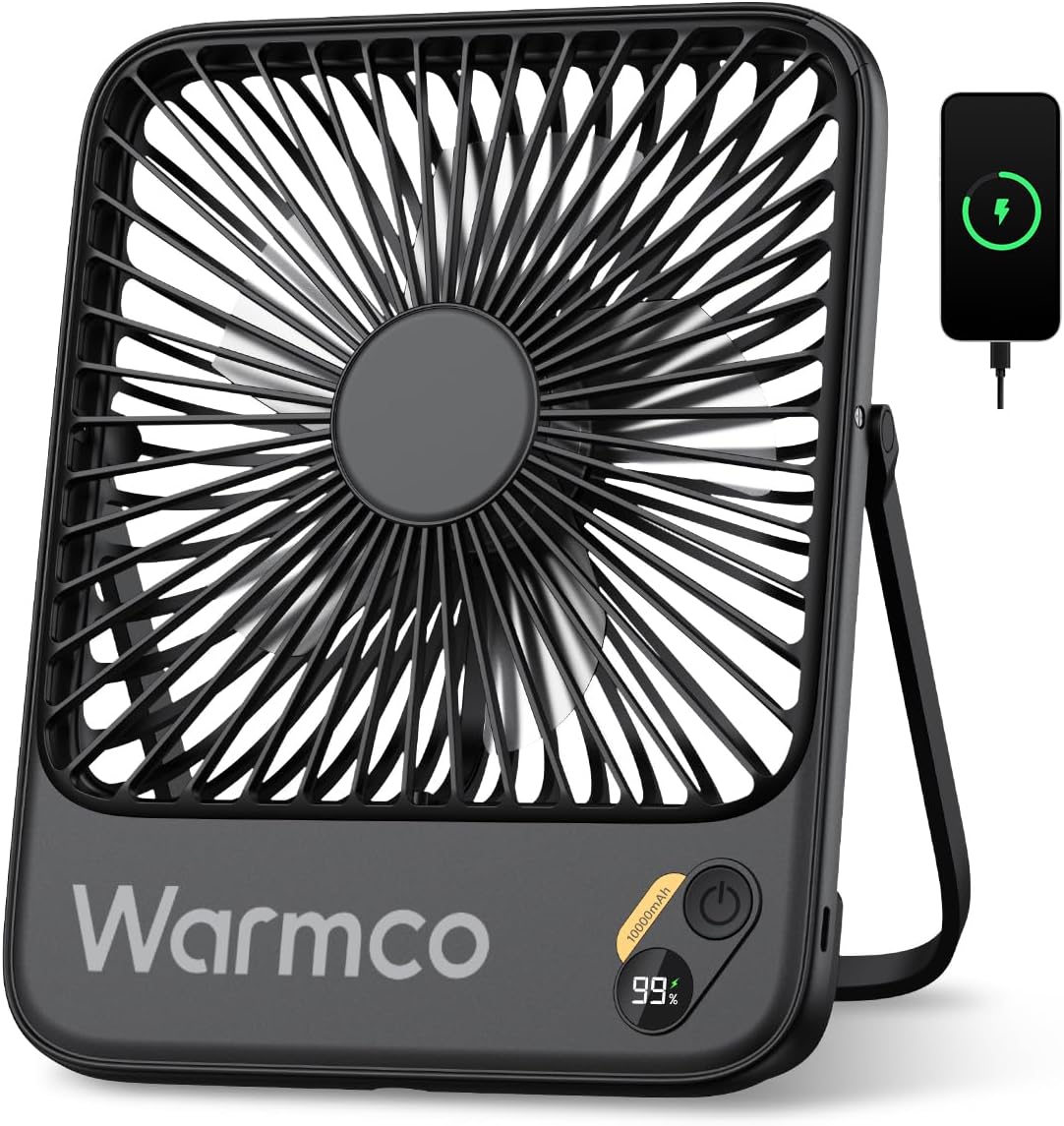
Alright, let's talk about a fan that ticks a lot of the right boxes for campervan life: the Warmco 10000mAh Portable Rechargeable Quiet Fan. This model is a popular choice for a reason, offering a strong set of features at a very competitive price point. At around £25.49, it represents excellent value for money.
Overview
The Warmco fan is designed to be a versatile, go-anywhere cooling solution. It’s primarily a desk/table fan but includes a handy hook, making it adaptable for hanging. The standout feature is its substantial 10,000mAh battery, which promises long run times, crucial for overnight use in a campervan. The "Quiet Fan" in its name isn't just marketing; it genuinely aims for low noise levels, a top priority for most of us trying to sleep in a small space.
Key Specifications
- Battery: 10,000mAh rechargeable lithium-ion battery. This is a robust capacity, putting it firmly in the "good for overnight" category.
- Charging: USB-C. A modern, convenient charging port that means you can use your phone charger or a dedicated USB-C cable from your van's outlets. It also supports 2A fast charging.
- Run Time: Advertised as up to 24 hours on the lowest speed. Real-world usage on medium settings will be more like 8-12 hours, which is still excellent for a full night's sleep.
- Speed Settings: Typically features 3-4 speed settings, allowing you to tailor the airflow.
- Noise Level: Marketed as "quiet." User reviews generally confirm it's very tolerable on lower settings, making it suitable for sleeping.
- Portability: Compact, lightweight design. Often includes a foldable hook for hanging.
- Other Features: Often includes power bank functionality (USB-A output) to charge small devices, and a timer function (e.g., 1/2/4 hours).
Pros: Why It's a Good Choice
- Exceptional Battery Life: The 10,000mAh battery is its biggest selling point. This means you can run it for a full night or several hours during the day without constantly worrying about recharging. For most builders, this is non-negotiable for off-grid comfort.
- Quiet Operation: While no fan is truly silent, the Warmco does an impressive job of keeping noise levels down, especially on the lower settings. This makes a huge difference when you're trying to sleep in a quiet campsite.
- Power Bank Functionality: The ability to charge your phone or tablet from the fan's battery is a fantastic bonus. It means one less power bank to carry and one less USB port you need to find in your van.
- USB-C Charging: Modern and convenient. You're likely already carrying USB-C cables for other devices, streamlining your charging setup.
- Versatile Placement: While a desk fan, the integrated hook allows you to hang it from your pop-top, a cupboard handle, or an awning pole. This adaptability is key in a campervan.
- Great Value: At around £25.49, you're getting a lot of features and battery capacity for your money. It punches above its weight compared to many more expensive alternatives.
Cons: Any Limitations?
- No Oscillation: This is a common omission in many portable fans at this price point. The Warmco fan typically features a fixed head, meaning you have to manually reposition it to change the airflow direction. If you need to cool multiple people or a wider area, this might be a drawback.
- Airflow Strength: While good for its size and quiet operation, it won't blast air like a larger mains-powered fan. For extreme heat, you might wish for a bit more oomph on the highest setting.
- Build Material: Predominantly plastic. While generally robust, it might not feel as premium as some higher-end metal-bodied fans. However, for the price, the build quality is perfectly acceptable.
Who is it for?
The Warmco 10000mAh Portable Rechargeable Quiet Fan is ideal for:
- Budget-conscious builders: You want excellent performance without breaking the bank.
- Overnight sleepers: The long battery life and quiet operation are perfect for keeping you cool through the night.
- Anyone needing versatile placement: The hook makes it adaptable for various spots in your van or awning.
- Those who value power bank functionality: An extra charge for your phone is always a win.
Price & Availability
At £25.49, this fan is regularly available from major online retailers like Amazon UK. You might also find similar models under different brand names, as this design is quite popular. Always check for current deals, but this price point is generally consistent.
My Take
From my experience, this Warmco fan, or very similar models, are solid contenders for your campervan. The 10,000mAh battery is the real star here. I've used fans with smaller batteries, and constantly worrying about them dying halfway through the night is just annoying. This one gives you peace of mind. The quiet operation is also a huge plus; there's nothing worse than a whirring fan drowning out the sounds of nature or keeping you awake. Yes, the lack of oscillation is a shame, but for personal cooling or directing air over a bed, it’s not a deal-breaker. If you're looking for a reliable, quiet, and long-lasting portable fan that won't drain your wallet, this Warmco model is definitely one to seriously consider. It's a smart bit of kit for any UK campervan.
Installation & Placement Tips
Getting the right fan is one thing; using it effectively is another. Strategic placement makes all the difference in maximising its impact in your campervan.
Strategic Positioning for Optimal Airflow
Don't just plonk your fan down anywhere. Think about where the air is coming from and where you want it to go.
- Opposite an open window or vent: This creates a powerful cross-breeze. Position the fan to blow air out of an open window, pulling fresh air in from another opening. This is often more effective for general cooling than just blowing air into the van. This means you're creating a negative pressure system, actively extracting hot, stale air.
- Near your bed: For sleeping, you’ll want the fan close enough to create a personal breeze. Clip it to a shelf above your head, hang it from the ceiling, or place it on a bedside table.
- To dry damp areas: Point the fan directly at wet towels, condensation on windows, or damp flooring after a rainy day.
- While cooking: Position it near your hob, blowing towards an open window or roof vent to help extract cooking smells and steam.
Creating a Cross-Breeze
This is the holy grail of campervan ventilation without AC. Open windows or vents on opposite sides of your van. Place your fan near one opening, blowing air either in or out.
- Blowing in: If you have a cooler breeze outside, position the fan to draw that fresh air into the van, pushing the warmer air out another opening.
- Blowing out: If the air inside is hotter or smellier than outside, position the fan to push that air out of an opening, drawing fresh air in from elsewhere. This is usually my favourite method for quick air changes.
Avoiding Obstacles
Make sure the fan's airflow isn't immediately blocked by curtains, furniture, or your own body. Give it clear space to move air around. This means you might need to experiment with different heights and angles.
Safety Considerations
- Cables: If charging while in use, ensure USB cables are neatly tucked away and not a trip hazard.
- Children and Pets: The grille should be fine enough to prevent small fingers or snouts from reaching the blades. Always supervise young children around active fans.
- Stability: Ensure the fan is on a stable, flat surface if freestanding. A fan toppling over could damage it or cause injury. If using a clip-on, ensure the clip is secure and won't slip.
In practice, a bit of trial and error will show you the most effective spots in your specific van layout. Don't be afraid to move it around throughout the day or night to adapt to changing conditions.
Power Management for Portable Fans
Even with a big battery, managing your fan's power efficiently is key to getting the most out of it, especially when you're off-grid.
Charging Strategies
- While driving: Your van's alternator is a powerful charger. Use your van's USB ports or a 12V adapter to charge your fan (and other devices) while you're on the move. This is free energy, so make the most of it.
- On mains hook-up (EHU): When at a campsite with 240V EHU, plug in a USB wall adapter and fully charge your fan. This preserves your leisure battery.
- Solar panels: If you have a robust solar setup on your roof, use it! Connect your fan to a USB charging point powered by your solar controller. This is sustainable and quiet. For most builders, this is the ideal way to top up.
- Dedicated power banks: Carry a large, dedicated power bank (20,000mAh+) as a backup for charging your fan if your van's power is low or unavailable.
Monitoring Battery Levels
Many portable fans have a small LED indicator that shows battery status. Pay attention to it. Don't wait until the fan dies to think about charging. If you know you'll need it overnight, make sure it's fully charged before dusk.
Impact on Leisure Battery (if using 12V direct)
If you opt for a 12V direct fan, remember it's drawing power straight from your leisure battery. While fans are generally low-power devices (typically 5-20W), continuous use over several hours will add up.
- Calculate: A 10W fan running for 8 hours uses 80Wh. If your 12V leisure battery is 100Ah (approx 1200Wh usable), that's less than 10% of your battery capacity. This means it's usually not a huge drain, but it's worth being aware of, especially if you have other high-draw appliances.
- Monitor: Use your leisure battery monitor to keep an eye on your overall power consumption.
For most builders, the low power draw of a rechargeable fan, only using leisure battery power to charge its internal battery, is a much more efficient approach than a continuously powered 12V fan. This means you're only drawing power from your main system intermittently, reducing constant drain.
Maintenance & Care
A little bit of looking after will ensure your portable fan stays efficient and lasts for many seasons of campervan adventures.
Cleaning Fan Blades
Dust and grime build up on fan blades, especially in a campervan environment with open windows and cooking. This reduces airflow and can make the motor work harder.
- Regular dusting: Use a soft cloth or a can of compressed air to dust the blades and grille regularly.
- Deeper clean: If the grille is removable (which I highly recommend looking for), take it off and wipe the blades down with a damp cloth. Make sure the fan is completely off and unplugged before doing this. Let it dry fully before reassembling. This means your fan will continue to move air effectively and quietly.
Battery Health
Modern lithium-ion batteries are robust, but a few habits can prolong their life.
- Avoid deep discharges: Don't let the battery completely drain to 0% repeatedly. Try to recharge it before it gets critically low.
- Don't overcharge: Once fully charged, unplug it. While most modern devices have protection against overcharging, continuous trickle charging isn't ideal for long-term battery health.
- Storage: If storing the fan for a long period (e.g., over winter), charge the battery to around 50-80% before putting it away. Storing a battery completely empty or completely full for extended periods can degrade it faster.
Storage When Not in Use
When you're not using the fan, store it in a clean, dry place. If it folds or collapses, take advantage of that to save space. A soft bag can protect it from dust and scratches while rattling around in your cupboards. This means your fan will be ready to go when the next heatwave hits, or when you simply need to air out the van.
Beyond the Fan: Complementary Cooling Strategies
While a portable fan is a fantastic tool, it's part of a larger strategy for keeping your campervan cool and comfortable. Combining it with other methods will give you the best results.
Insulation and Window Covers
The most fundamental step to temperature control is good insulation in your van build. If you haven't built yet, prioritise this. If your van is already converted, invest in high-quality thermal window covers. These are thick, reflective covers that suction or magnet to your windows. They block out sunlight and heat during the day and retain warmth at night. This means your fan has less work to do. They make a massive difference, easily dropping internal temperatures by several degrees on a sunny day.
Roof Vents and Skylights
These are your primary exhaust systems. Ensure they are clean and fully functional.
- Fan-assisted vents: If you have a powered roof vent (like a Maxxair Fan or Fiamma Turbo Vent), use it in conjunction with your portable fan. Point your portable fan towards an open window, and use the roof vent to extract the air, creating a powerful flow-through.
- Passive vents: Even basic mushroom vents help. Ensure they are open when possible.
Shade
- Strategic parking: Whenever possible, park with the sun on the least windowed side of your van, or better yet, under a tree. Even a few hours in the shade can prevent your van from becoming an oven.
- Awnings: Deploy your awning! It creates a large patch of shade down the side of your van, significantly reducing heat ingress through windows and the side panel. This means you’re blocking the heat before it even gets inside.
- Pop-top roofs: If you have a pop-top, opening the canvas windows allows for a huge amount of airflow, especially when combined with a fan.
Ventilation While Cooking
Cooking generates a lot of heat and steam.
- Open windows/vents: Always open your roof vent and a window or two when cooking.
- Position your portable fan: As mentioned earlier, point your portable fan towards an open vent or window near the hob to help extract steam and cooking odours quickly. This means your van won't smell of last night's dinner for days.
Moisture Control
Beyond just drying clothes, controlling ambient moisture is key.
- Dehumidifiers: Small desiccant dehumidifiers (like moisture traps) can help absorb moisture in the air.
- Air circulation: The fan itself helps by circulating air and preventing condensation from settling.
- Ventilation: Ensure good ventilation, especially at night, to reduce condensation from breathing.
By integrating these strategies, your portable fan becomes even more effective, contributing to a consistently comfortable and fresh environment in your campervan, no matter what the unpredictable UK weather throws at you.
Common Mistakes to Avoid
Even with the best intentions, it's easy to make a few missteps when choosing and using a portable fan in your campervan. Learning from these common errors can save you frustration and money.
Underestimating Battery Life
This is probably the biggest mistake. Many people see a cheap fan and grab it, only to find its "8-hour" battery life means 2 hours on a usable setting. For most builders, needing to recharge constantly is a huge annoyance, especially overnight. Always look for a fan with a robust battery capacity (10,000mAh or more for overnight use) and check real-world reviews for actual run times on medium settings. This means you avoid waking up in a sweat at 3 AM because your fan died.
Ignoring Noise Levels
A fan might move a lot of air, but if it sounds like a jet engine, you won't use it for long, particularly when trying to sleep. Campervans are small spaces; every little noise is amplified. Don't just trust "quiet" claims; actively seek out reviews that comment on noise, especially on lower settings. A fan that makes you turn it off because of the racket is a wasted purchase.
Buying Too Small or Weak
A tiny handheld fan might seem cute, but it won't do much for circulating air in your entire van. While you don't need industrial power, ensure your chosen fan has enough oomph to make a noticeable difference. Consider the blade size and motor power. A fan that's too weak will just leave you feeling frustrated and still hot. This means you're buying a glorified paperweight instead of a functional cooling device.
Not Considering Placement Options
A freestanding fan is great, but if all your surfaces are cluttered, where will it go? Or perhaps you want airflow directly over your bed, but a desk fan can't reach. Think about how you'll use the fan and where it needs to go. Fans with clips, hooks, or even magnetic bases offer far more flexibility in a compact campervan. This means you're not stuck trying to balance a fan precariously on a stack of books.
Forgetting to Clean
A dusty fan is an inefficient fan. Over time, dust and grime build up on the blades and grille, reducing airflow and potentially making the motor work harder and louder. Neglecting basic cleaning means your fan won't perform as well as it should, and its lifespan might be shortened. Make it a habit to give your fan a quick wipe-down every now and then.
By avoiding these common pitfalls, you'll be much better equipped to select a portable fan that genuinely enhances your campervan experience, providing effective and comfortable airflow whenever you need it.
Conclusion
So, there you have it. A portable fan for your campervan isn't just another gadget; it's a vital piece of kit for comfort, air quality, and overall enjoyment of your adventures across the UK. From those unexpected heatwaves to shifting cooking odours or drying out damp gear, a well-chosen fan tackles a surprising array of campervan challenges.
We've explored the crucial features: a robust, long-lasting battery (10,000mAh is your friend here), quiet operation for peaceful nights, versatile mounting options, and enough airflow to actually make a difference. We’ve looked at the different types, from the adaptable clip-on to the feature-packed camping fan, and taken a deep dive into the Warmco 10000mAh Portable Rechargeable Quiet Fan, highlighting its excellent value, impressive battery life, and quiet performance – a strong contender for any campervan owner.
Remember, it’s not just about the fan itself; it’s how you use it. Strategic placement, smart power management, and a bit of regular maintenance will ensure your fan serves you well for many trips to come. And don't forget to combine it with other cooling strategies, like good insulation and awnings, for the ultimate comfortable setup.
For most builders, investing a little more in a quality, feature-rich fan like the Warmco model we discussed will pay dividends in comfort and convenience. Don't compromise on a good night's sleep or a fresh-smelling van. Choose wisely, stay cool, and enjoy every moment on the open road. Happy travels!